Can I drink almond milk with ulcerative colitis?
By Jude Horak, UC patient. Sources checked 2026-08-12.
Have Crohn's instead? Jump to the Crohn's notes
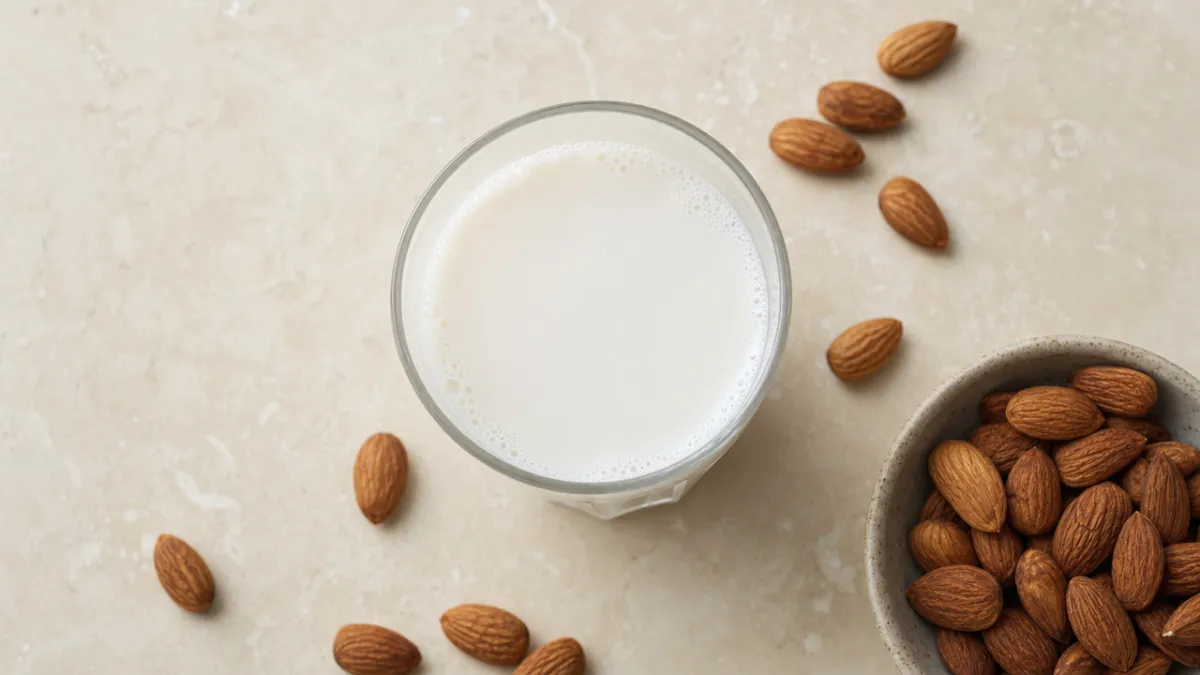
Almond milk contains no lactose, so it avoids the most common dairy-related trigger in ulcerative colitis, and it's considered low-FODMAP in standard serving sizes even though almonds themselves are higher in FODMAPs, likely because of how dilute the final product is. It's naturally lower in protein than dairy milk unless fortified, so it isn't a direct calorie or protein substitute.
During a flare
Generally well tolerated during a flare since it's lactose-free and low in fat.
In remission
A reasonable everyday milk swap in remission; choose versions fortified with calcium and vitamin D to help replace what's lost by cutting dairy.
What the research says about almond milk and UC
Monash FODMAP's guide to milk alternatives lists almond milk as low FODMAP at a standard one-cup serving, which surprises people who know that almonds themselves are moderate to high in FODMAPs at larger amounts. Monash's explanation is dilution: a cup of almond milk contains only a small quantity of ground almonds, and the fructans and GOS in that quantity fall below the threshold that tends to trigger symptoms. Their companion post on dairy-free beverages and yogurts makes the same point and adds that almond-based yogurts vary more, since some are thickened with ingredients that add FODMAPs back.
Both sources come from irritable bowel syndrome research rather than ulcerative colitis, and neither addresses inflammation. What they establish is that almond milk avoids lactose entirely and is unlikely to add a FODMAP load, which removes the two most common reasons a milk product causes gas or diarrhea in someone with UC. The rest of the assessment here is general nutrition guidance: unfortified almond milk is low in protein and calcium compared with dairy, so it replaces milk as a drink but not as a nutrient source unless fortified, and sweetened or thickened versions add sugar and gums that Monash's low FODMAP rating does not account for.
If you have Crohn's instead of UC
I have UC, not Crohn's, so this part is research rather than experience.
For most people with Crohn's, almond milk works much as it does in UC. The exception is anyone with a history of kidney stones, fat malabsorption or ileal surgery. Cleveland Clinic describes enteric hyperoxaluria, in which a gut condition such as Crohn's leads the body to absorb extra oxalate, and it lists nuts and nut butters among the high-oxalate foods to limit. A 2024 study in Nutrients notes that stones are more common in Crohn's after intestinal resection, and among its 27 patients, the length of ileal resection tracked with how much oxalate was absorbed.
Neither source gives an oxalate figure for almond milk, which contains far less almond per cup than a handful of nuts. So this is a question for your care team rather than a reason to pour the carton away. If oxalate has come up in your care, ask whether almond milk fits your plan.
Based on: Cleveland Clinic; National Institutes of Health (PMC), from Nutrients 2024; Cleveland Clinic. More on how Crohn's and UC diets differ.
Ways to make it gentler
- Choose unsweetened, fortified versions
How I handle almond milk
When I want something in my coffee or cereal that I do not have to think about, I reach for almond milk. My selection rule is unsweetened and fortified, with as few ingredients as I can find: almonds, water, calcium, vitamins, and ideally not much else. Some cartons carry a long list of gums and emulsifiers, and while I have no evidence those bother me, I prefer not to test them during a flare. I do not treat almond milk as nutrition in the way I treat lactose-free milk; it is a liquid that makes oatmeal and coffee pleasant, and I get my protein and calcium elsewhere. The one thing I am careful about is the sweetened vanilla kind, which can carry as much sugar as a soda and does me no favors. When I want creaminess I use the barista versions, which have more fat and gums, and I keep those for good weeks.
How much, and how to test it
Almond milk is low risk enough that a full cup is a reasonable first serving, in coffee, over cereal, or in a smoothie. The things worth testing separately are the additives, so start with an unsweetened brand that has a short ingredient list, and if that passes, you can try others. Over the next day, watch for bloating or looser stool, which with almond milk more often points to a gum, a sweetener, or something else in the meal than to the almonds. Two or three uneventful cups over a week is enough to call it tolerated.
What you get from almond milk
Unsweetened almond milk is mostly water: about 30 to 40 calories, 1 gram of protein, and little fat per cup. Fortified brands add calcium, often to a level similar to dairy milk, plus vitamins D and E. That fortification matters for people with ulcerative colitis who have cut dairy, because calcium and vitamin D needs do not fall when milk leaves the diet, and steroid courses raise the stakes for bone. Protein has to come from elsewhere.
Questions people ask about almond milk and UC
Is almond milk good for ulcerative colitis?
It is a gentle milk substitute: no lactose, very little fat, and low FODMAP at a standard serving according to Monash. That makes it one of the least likely milks to cause gas or loose stool. It is not a nutritional match for dairy, though, so its benefit is avoiding a trigger rather than adding anything to your diet, unless you choose a fortified brand for the calcium and vitamin D.
Is almond milk bad for colitis?
Rarely. The main ways almond milk goes wrong are additives rather than almonds: some brands use carrageenan, gellan gum, or sunflower lecithin as thickeners, and sweetened versions carry a lot of sugar. A few people also react to almonds as a nut allergy, which is a separate issue. Choosing an unsweetened brand with a short ingredient list removes most of what could cause a problem.
Can I eat almonds if almond milk is fine with my colitis?
Not necessarily. Almond milk contains a small amount of finely ground almond diluted in water, while a handful of whole almonds delivers far more fiber, fat, and FODMAPs, plus a hard texture that is commonly reported as a trigger during flares. Tolerating the milk says very little about tolerating the nuts. Smooth almond butter in small amounts is a middle step for anyone wanting to test.
Does almond milk have enough calcium and vitamin D to replace milk?
Only if fortified, and most commercial brands are. Check the label for calcium at or near 300 milligrams per cup and for added vitamin D, which are roughly what dairy milk supplies. Homemade almond milk and some minimally processed brands have almost none. Protein is the harder gap: almond milk has about one gram per cup against eight in dairy, so it needs backing up with other protein sources, especially during recovery from a flare.
Can you drink almond milk with a Crohn's stricture?
Texture is rarely the issue with almond milk itself. Cleveland Clinic's low-fiber guide says people with strictures want food broken into small particles so it does not get stuck, and it lists whole nuts to avoid while counting smooth peanut butter as a lower-fiber choice. A strained nut milk sits at the smooth end of that scale. The concern returns with what gets blended in: whole almonds, seeds and berry skins in a smoothie can leave coarse pieces unless fully pureed.
Sources
- Milk alternatives on a low FODMAP diet (Monash FODMAP)
- Dairy alternatives (beverage and yoghurt) - low FODMAP options (Monash FODMAP)
- Hyperoxaluria (Cleveland Clinic)
- Intestinal Oxalate Absorption, Enteric Hyperoxaluria, and Risk of Urinary Stone Formation in Patients with Crohn's Disease (National Institutes of Health (PMC), from Nutrients 2024)
- How To Follow a Low-Fiber Diet (Cleveland Clinic)
Written by Jude Horak, a UC patient. Sources last checked 2026-08-12. Spotted an error? Tell me.