Can I eat cottage cheese with ulcerative colitis?
By Jude Horak, UC patient. Sources checked 2026-08-12.
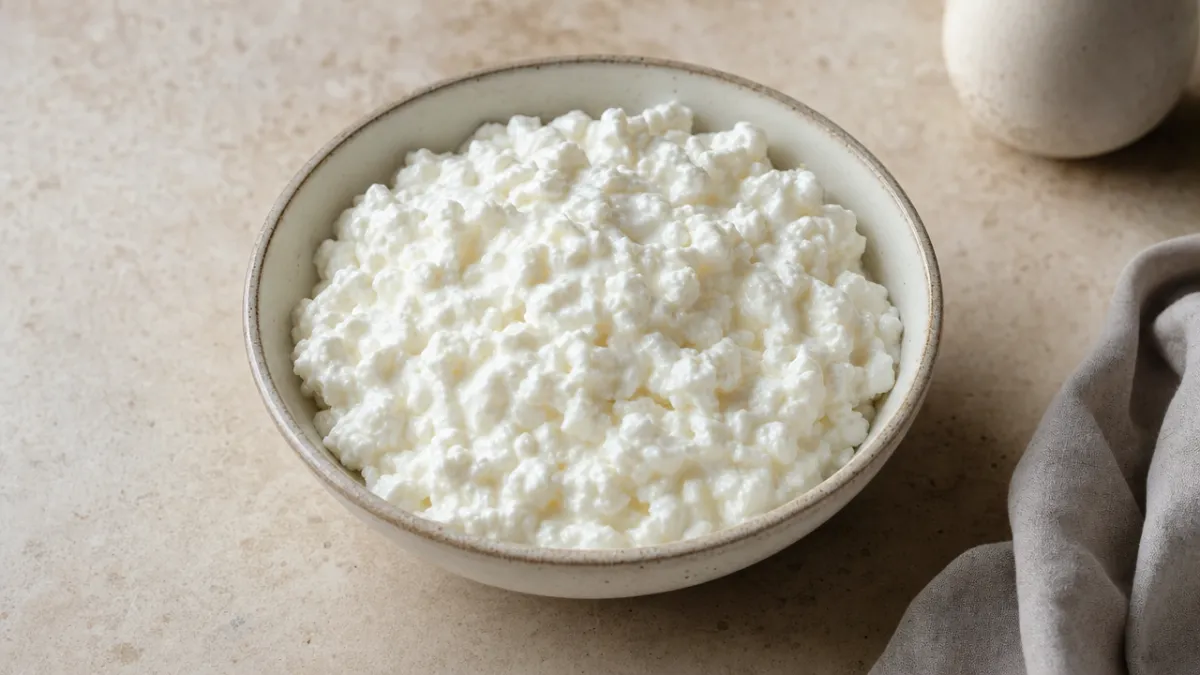
Cottage cheese is a fresh, unaged cheese, so it retains more lactose than hard aged cheeses even though it has less than a glass of milk. As with other dairy, symptoms after eating it in ulcerative colitis are usually a lactose-tolerance issue rather than the cheese driving inflammation; a broad review found no strong evidence that dairy itself worsens IBD course.
During a flare
Because it's higher in lactose than aged cheese, keep portions small during a flare if dairy tends to bother you.
In remission
A good source of protein and calcium to test in remission; lactose-free versions are available if regular cottage cheese still causes symptoms.
What the research says about cottage cheese and UC
Monash FODMAP's lactose and dairy guide places cottage cheese in the middle of the dairy lactose range: as a fresh, unripened cheese it keeps some of the whey and therefore more lactose than aged cheddar or parmesan, but draining removes enough that a modest serving stays below the low FODMAP cutoff, with larger servings tipping into moderate or high. Monash also lists lactose-free cottage cheese as a fully low FODMAP alternative. This gives a practical rule for ulcerative colitis even though the data was gathered for irritable bowel syndrome: portion size is the lever with cottage cheese, more than with any hard cheese.
The PMC systematic review on milk and dairy in inflammatory bowel disease did not examine cottage cheese on its own; its finding that dairy as a category shows no consistent effect on disease course is the basis for saying cottage cheese is unlikely to drive inflammation. The review did document how widely IBD patients restrict dairy based on belief rather than testing, which is relevant because cottage cheese is a high-protein, soft food that many people cut unnecessarily. Whether small curd, large curd, or whipped styles differ in tolerance has not been studied, and the salt and stabilizers in some brands are outside what either source covers.
Ways to make it gentler
- Keep servings modest
- Try lactose-free cottage cheese if standard versions cause gas or bloating
Safer swaps
- lactose-free cottage cheese
- hard aged cheese
- Greek yogurt
How I handle cottage cheese
When I do not feel like cooking, cottage cheese is my protein, so my approach is built around keeping it easy to tolerate rather than avoiding it. I buy the small-curd, 2 percent kind with a short ingredient list, and I eat it in half-cup servings rather than the whole tub in one sitting, because the lactose in a big bowl is enough to notice. I lean savory: a pinch of salt and pepper on toast, or stirred into scrambled eggs, which also warms it up. Cold cottage cheese straight from the fridge on an empty stomach is the combination I steer clear of when my gut is unsettled. If I am in a stretch where even small servings feel wrong, I switch to the lactose-free version for a while and keep the habit rather than dropping the food.
How much, and how to test it
A quarter cup is a sensible starting serving, eaten with a meal on a calm day. Cottage cheese carries more lactose than aged cheese, so give it a full day before deciding it is fine, watching for gas, bloating, and any change in stool. If a quarter cup passes over two or three tries, move to half a cup, which is where most people either settle or start to notice symptoms. Bloating that appears only at the larger serving is the lactose threshold showing itself; keeping portions under it, or switching to lactose-free cottage cheese, usually resolves it without giving up the food.
What you get from cottage cheese
Half a cup of low-fat cottage cheese provides roughly 12 to 14 grams of protein, which rivals an egg and a half, plus around 100 milligrams of calcium and useful phosphorus and B12. That protein density in a soft, no-chewing-required food is exactly what helps during recovery from a flare, when muscle loss and low appetite tend to travel together. It is high in sodium, so people watching salt, or dealing with fluid shifts on steroids, may want to check labels.
Why this one shows up on trigger lists
Cottage Cheese is flagged for one of the properties that most commonly cause UC symptoms. Each page explains the mechanism and lists every other food that carries it.
Questions people ask about cottage cheese and UC
Can you eat cottage cheese with colitis?
Most people with colitis can, in modest servings. It is soft, high in protein, and lower in lactose than milk, though not as low as aged cheese, so the serving size matters more than with cheddar. During a flare, a small amount with a meal is the safer approach, and a lactose-free version removes the main reason it might cause gas or loose stool.
Is cottage cheese bad for ulcerative colitis?
The pooled research on dairy in IBD does not show it worsening the disease, and nothing about cottage cheese specifically suggests it does. Where it goes wrong for people is lactose: a large bowl can carry enough to ferment in the colon and cause bloating or looser stool in someone with reduced lactase. That is a tolerance issue, not inflammation, and it usually responds to smaller servings.
Is cottage cheese good for an anti-inflammatory diet?
It is neutral rather than actively anti-inflammatory. Cottage cheese has no known inflammatory properties in the cited research and offers a lot of protein for few calories, which supports recovery. It does not contain the omega-3 fats or polyphenols that anti-inflammatory eating plans usually emphasize. In an IBD context, its value is as a well-tolerated protein source that makes it easier to eat enough, not as a food that lowers inflammation on its own.
Small curd or large curd: does it matter with colitis?
Curd size is about texture, not digestion. Both are made the same way and carry similar lactose and protein per serving. Some people find small curd easier to eat when their appetite is low or their mouth is sore, and it blends more smoothly into eggs or sauces. Whipped cottage cheese is another option with the same nutrition. Choose by texture preference and focus on portion size instead.
Recipes that use cottage cheese
Sources
- Lactose and dairy products on a low FODMAP diet (Monash FODMAP)
- Effects of Milk and Dairy on the Risk and Course of Inflammatory Bowel Disease versus Patients' Dietary Beliefs and Practices: A Systematic Review (PMC (National Library of Medicine))
Written by Jude Horak, a UC patient. Sources last checked 2026-08-12. Spotted an error? Tell me.