Can I drink orange juice with ulcerative colitis?
By Jude Horak, UC patient. Sources checked 2026-08-12.
Have Crohn's instead? Jump to the Crohn's notes
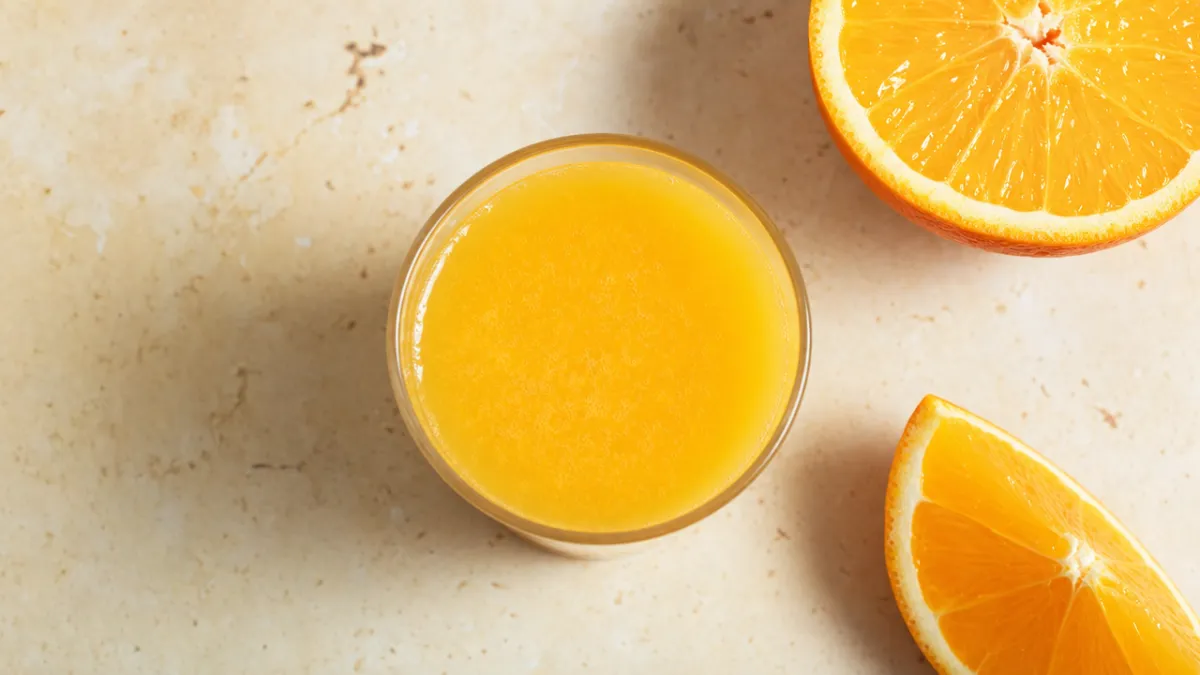
Orange juice's natural acidity can add to stomach discomfort for some people, and like other juices it concentrates the sugar of the fruit without the fiber. Monash lists whole oranges as low FODMAP and apple juice as high; orange juice itself is served-size dependent in the Monash app, so a small glass is usually the safer starting point and a large one behaves more like other sugary juices.
During a flare
The acidity and concentrated sugar can be a commonly reported irritant during a flare, so smaller diluted amounts tend to be better tolerated than a full glass.
In remission
Most people in remission tolerate orange juice reasonably well in modest amounts (roughly half a cup at a time), though individual acid sensitivity varies.
What the research says about orange juice and UC
Monash University's FODMAP food list places oranges among low FODMAP fruits, alongside mandarins, cantaloupe, and kiwifruit, and lists apple juice, but not orange juice, in its high FODMAP examples. The list is about IBS and fermentable carbohydrates, not UC, and serving-size specifics for orange juice live in the Monash app rather than on the page. What this supports is narrow: the sugars in orange juice are mostly ones that absorb well, so it is less likely than apple or pear juice to draw water into the bowel through a FODMAP mechanism. It says nothing about acidity, and nothing about inflammation.
Orange juice, and juice in general, goes unmentioned in Cleveland Clinic's ulcerative colitis diet article. Its flare-period advice favors water, broth, soups, and oral rehydration solutions for fluid, and skinless fruits and fruit products such as applesauce, bananas, and melon for fruit, which is the closest it comes to the question. The caution rating on this page therefore combines a favorable FODMAP profile from Monash with general concern about concentrated sugar and acid during active disease, plus the widely reported experience that citrus stings an irritated gut. There is no orange-juice-specific study in people with UC in either source.
If you have Crohn's instead of UC
I have UC, not Crohn's, so this part is research rather than experience.
With a Crohn's stricture, orange juice can be one of the easier ways to get fruit, and the form matters more than it does in UC. Crohn's & Colitis UK lists fruit juice among the gentler fiber sources for people with a narrowing, while its stricture advice flags the skins, seeds and stalks of fruit as things that could block the gut. Cleveland Clinic explains the goal: with strictures, you want food broken into small particles so it does not get stuck.
That reverses a swap suggested elsewhere on this page. The membranes wrapping each orange segment are tough and stringy, the kind of material stricture advice tends to limit, so for this group pulp-free juice is usually gentler than a whole orange. Pulpy juice sits in between, and straining it is a simple fix. If you are unsure whether you have a stricture, ask your gastroenterologist before changing anything.
Based on: Crohn's & Colitis UK; Cleveland Clinic; National Institutes of Health (PMC), from Gut 1985. More on how Crohn's and UC diets differ.
Ways to make it gentler
- Dilute with water
- Drink with food rather than on an empty stomach
Safer swaps
- diluted orange juice
- whole orange segments
- water
How I handle orange juice
Orange juice is a half-and-half drink for me, literally: I cut it with an equal amount of water, which drops the acid and the sugar per sip and turns a small glass into a bigger one that lasts. Pulp-free is my default when things are touchy, because the pulp is fiber and that is the last thing an irritated colon needs. In remission I am fine with a small glass of pulpy juice with breakfast, after food rather than before it, since acid on an empty stomach gives me a sour, uneasy feeling. Cold from the fridge is fine, but not iced. During a flare I mostly skip it, or I take a few diluted sips when I want the taste of something fresh, and I make sure it is not doing the job water and electrolytes should be doing. A whole orange, when I can manage it, sits better than the juice.
How much, and how to test it
A first test is a quarter cup of pulp-free orange juice mixed with a quarter cup of water, taken with breakfast. Make it the only new thing that day. Heartburn or a sour stomach in the hour after points to acid; a looser stool or cramping later that day or the next points to sugar, so note both separately across the following 72 hours. If it passes, move to half a cup diluted, then half a cup straight, then try a pulpy version separately. Back off if acid symptoms appear or if stools loosen, and lean on diluted versions during flares if you want it at all.
What you get from orange juice
Orange juice is a genuine source of potassium, roughly 450 milligrams per cup, plus vitamin C, folate, and about 110 calories from natural sugar. Potassium loss during diarrhea is a real UC concern, and fortified versions add calcium and vitamin D, both relevant if you have taken steroids. Vitamin C also improves absorption of plant-based iron eaten at the same meal, relevant to anemia. The trade-off is that the sugar arrives without fiber and the acid can irritate, so dilution keeps the benefits and trims the cost.
Why this one shows up on trigger lists
Orange Juice is flagged for 2 of the properties that most commonly cause UC symptoms. Each page explains the mechanism and lists every other food that carries it.
Questions people ask about orange juice and UC
Is orange juice okay to drink with ulcerative colitis?
Often yes in modest amounts, especially in remission, and it is one of the better juice choices on FODMAP grounds because orange sugars absorb well. The two things that bother people are the acidity, felt in the stomach, and the concentrated sugar, felt in the bowel. Diluting it, choosing pulp-free during rough patches, and drinking it with food address both. During a flare, small diluted sips are the common compromise.
Is orange juice with pulp worse for colitis?
During a flare, usually. Pulp is fiber, and fiber is what most people with active UC are trying to keep low. Pulp-free juice removes that variable. In remission pulp is fine for many people and adds back a little of what juicing strips out. If you notice more cramping or visible undigested material after pulpy juice, that is a reasonable cue to stay pulp-free for a while.
Does the acid in orange juice irritate colitis?
The acid is felt mainly in the stomach and esophagus, as heartburn or a sour, uneasy feeling, rather than in the colon where UC lives. It does not appear to worsen the inflammation itself. People with reflux alongside UC tend to notice it most. Drinking juice after food instead of on an empty stomach, and diluting it, are the two adjustments that most often settle it.
Can orange juice help with hydration during a flare?
A little, but it is not built for the job. Full-strength juice is high in sugar and low in sodium, which is roughly the opposite of what an oral rehydration solution provides. Its potassium is useful, though. A reasonable compromise during heavy diarrhea is diluted juice for taste and potassium alongside water and a proper rehydration drink for the actual fluid and salt replacement.
Does orange juice need to be pulp-free if you have Crohn's without a stricture?
Usually not. Crohn's & Colitis UK says fiber does not need limiting when Crohn's is under control unless there is a stricture. A small, older trial points the same way: in 1985, 70 Italian patients with non-narrowing Crohn's were randomized to a low-residue or normal diet for an average of 29 months, and the groups showed no difference in symptoms, surgery or blockages. Going pulp-free during a flare is a comfort choice, much as it is in UC.
Sources
- High and low FODMAP foods (Monash University FODMAP)
- The Ulcerative Colitis Diet: What To Eat and Avoid (Cleveland Clinic)
- Food and Crohn's or Colitis (Crohn's & Colitis UK)
- How To Follow a Low-Fiber Diet (Cleveland Clinic)
- Low residue or normal diet in Crohn's disease: a prospective controlled study in Italian patients (National Institutes of Health (PMC), from Gut 1985)
Written by Jude Horak, a UC patient. Sources last checked 2026-08-12. Spotted an error? Tell me.