Can I eat seeds with ulcerative colitis?
By Jude Horak, UC patient. Sources checked 2026-08-12.
Also searched as: sunflower seeds, pumpkin seeds, sesame seeds, chia seeds.
Have Crohn's instead? Jump to the Crohn's notes
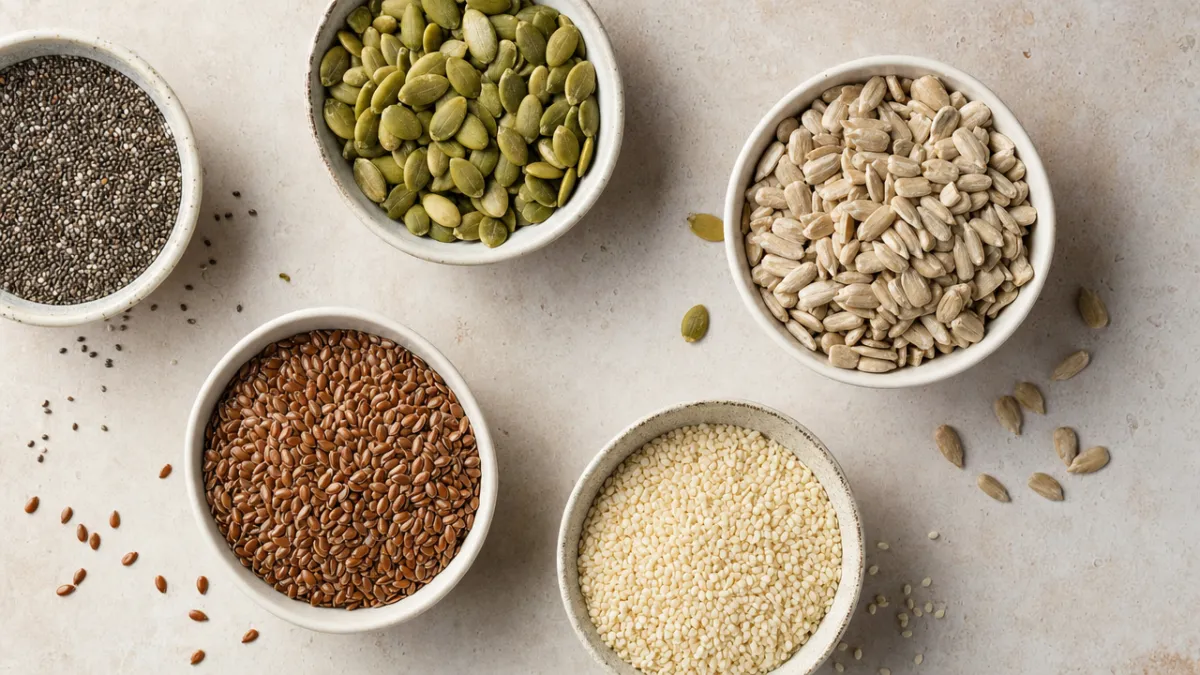
Seed hulls are small, hard, and largely indigestible. Case reports describe whole seeds, including sunflower seeds, becoming lodged at the naturally narrow end of the small bowel and causing obstruction, especially where motility or bowel diameter is already compromised. General IBD guidance groups seeds with other high-fiber foods to limit during flares.
During a flare
Whole seeds (sunflower, pumpkin, sesame, chia) are commonly avoided during flares; low-residue guidance for flares and procedures lists seeds among foods to avoid.
In remission
In remission, ground seeds (like flaxmeal) are often better tolerated than whole seeds; reintroduce slowly and in small amounts.
What the research says about seeds and UC
The Hillingdon Hospitals NHS Foundation Trust low-residue diet sheet names seeds specifically, giving pumpkin, sunflower, and sesame as examples of foods to avoid, and it even carries the exclusion into pretzels, which are permitted only without sesame seeds. Its stated concern is fiber that is poorly or partially digested and can get caught in a narrowing of the bowel, which is why it lists bowel obstruction risk alongside IBD flares as reasons to follow the diet. The University Hospitals Sussex NHS Foundation Trust sheet takes the same approach, grouping seeds with nuts and whole grains among the high-fiber foods a short-term low-residue diet removes.
The research paper in this entry's sources is a case report in PMC describing a 72-year-old man with a small bowel obstruction caused by a mass of sunflower seeds, with no other risk factors, after eating a large quantity of them. The authors note that seed bezoars are rare in adults and are more often reported as rectal impactions in children. That is a worst-case illustration, not evidence about everyday seed eating in ulcerative colitis, and I have not found a study that tested seeds in people with UC. The flare verdict follows the dietetic sheets, and the case report mainly explains why whole seeds in large quantities deserve more caution than most foods on this site.
If you have Crohn's instead of UC
I have UC, not Crohn's, so this part is research rather than experience.
Seeds are one of the clearer cases where Crohn's changes the advice, because a stricture turns a small, hard hull into a potential obstacle. Crohn's & Colitis UK describes a stricture as a section of gut narrowed by ongoing inflammation or scar tissue, which can make it hard for food to pass and, if very narrow, cause a blockage. Its guidance for people with a stricture is to consider limiting fibrous foods, naming seeds alongside nuts and fruit and vegetable skins. Sunflower, pumpkin, and sesame seeds are small enough to swallow without chewing, which is part of why they land on these lists.
Without a stricture, the picture looks much like it does in UC. With one, the seeds baked onto bread crusts, bagels, and crackers count as much as a deliberate handful, so help from a dietitian in reading labels is often worthwhile.
Based on: Crohn's & Colitis UK; National Institutes of Health (PMC), from Nutrients 2024; National Institutes of Health (PMC), from Frontiers in Nutrition 2023. More on how Crohn's and UC diets differ.
Ways to make it gentler
- use ground seeds instead of whole
- strain seeds out of jams or sauces if sensitive
Safer swaps
- ground flaxseed in small amounts
- seed-free granola
How I handle seeds
Seeds are sneaky, and that is why I read labels for them more than for anything else. Whole nuts announce themselves; seeds hide in bread crusts, crackers, salad toppings, burger buns, jam, and the everything seasoning on a bagel. During a flare I avoid all of them in whole form, including chia, which swells into a gel but still arrives as a lot of small hulls, and I choose seedless jam and plain buns. What I do use is ground flaxseed in tiny amounts stirred into oatmeal once I am improving, because grinding takes the hull problem away and the amount is small. In remission I bring seeds back cautiously and one type at a time, hulled sunflower and pumpkin seeds first, since the shell is already gone, and I no longer eat them by the handful the way I might have before. A sprinkle on top of something soft is my ceiling.
How much, and how to test it
Begin with ground seeds, not whole ones: a teaspoon of ground flaxseed or chia stirred into something soft, once a day for two or three days. Watch for bloating, extra gas, and looser stools, which are the common early signs, and for hulls in the stool if you have moved on to whole seeds. If ground seeds pass, try a teaspoon of hulled sunflower or pumpkin seeds sprinkled on a meal, chewed well, and wait another few days. Increase by a teaspoon at a time. Large handfuls of whole seeds, especially with shells, are worth avoiding altogether.
What you get from seeds
Seeds punch well above their size: pumpkin seeds carry roughly 30 grams of protein, 8 milligrams of iron, and plenty of magnesium and zinc per 100 grams, sunflower seeds around 20 grams of protein and generous vitamin E, and chia and flax add omega-3 fats. That iron is genuinely relevant to anyone with UC-related anemia, and the zinc and magnesium are often depleted by chronic diarrhea. The catch is fiber, about 6 to 34 grams per 100 grams depending on the seed, which is why the ground form is the practical way to get the benefit.
Why this one shows up on trigger lists
Seeds is flagged for one of the properties that most commonly cause UC symptoms. Each page explains the mechanism and lists every other food that carries it.
Questions people ask about seeds and UC
Are chia seeds good for ulcerative colitis?
It depends on the state of the disease. Chia is rich in soluble fiber and omega-3 fats, which sounds ideal, but it is still a whole seed with a hull, and it absorbs many times its weight in water and swells. During a flare that bulk tends to work against you, and low-residue sheets exclude seeds without exception. In remission, a teaspoon of ground or well-soaked chia is often tolerated and is the sensible way to test it.
Can I eat seeds during a UC flare?
Whole seeds are one of the more consistent entries on hospital lists of foods to avoid while a bowel is inflamed, so most dietitians would say to hold off. The hulls do not break down, they add bulk during diarrhea, and in large amounts they can clump. Ground seeds are a different matter: a small amount of flaxmeal or ground chia stirred into a soft food is often manageable as symptoms improve, because the hull problem has been removed.
Do sunflower seeds cause bowel obstruction?
Rarely, and usually only in large quantities or when eaten with the shell. The case report cited on this page describes an adult with no other risk factors who developed a small bowel obstruction after eating a large number of sunflower seeds, and the authors point out that most seed bezoars occur in children. For someone with UC and no narrowing, the everyday risk is symptom irritation rather than blockage. Anyone with a known stricture is usually told to skip whole seeds entirely.
What about seeds in bread, crackers, and jam?
They count. A seeded bread crust or an everything bagel can deliver more whole seeds than a deliberate sprinkle, and raspberry or strawberry jam carries pips that hospital sheets specifically flag. During a flare the practical move is plain white bread, plain crackers, and seedless or sieved jam, which is what the Hillingdon list recommends. In remission most people can stop worrying about the odd sesame seed on a bun and save the caution for larger amounts.
Are ground chia or flax seeds OK with Crohn's strictures?
That is a question for a dietitian rather than a label. A 2024 Nutrients review reports that fiber guidance for IBD broadly matches general population advice, with one exception: people with symptomatic stricturing Crohn's may benefit from personalized support that limits insoluble fiber while keeping soluble-fiber foods and enough fluid. Chia and flax contain soluble fiber, and grinding removes the intact hull, but a 2023 systematic review found no trials of fiber changes for strictures and describes the soluble-fiber approach as an option that still needs study.
Sources
- Low-residue diet (The Hillingdon Hospitals NHS Foundation Trust)
- A Rare Case of Small Bowel Obstruction Due to Sunflower Seeds Consumption in an Adult (PMC)
- Low residue diet (University Hospitals Sussex NHS Foundation Trust)
- Crohn's Disease (Crohn's & Colitis UK)
- Dietary Fiber in Inflammatory Bowel Disease: Are We Ready to Change the Paradigm? (National Institutes of Health (PMC), from Nutrients 2024)
- Nutritional interventions in adult fibrostenotic Crohn's disease: A systematic review (National Institutes of Health (PMC), from Frontiers in Nutrition 2023)
Written by Jude Horak, a UC patient. Sources last checked 2026-08-12. Spotted an error? Tell me.