Can I eat kale with ulcerative colitis?
By Jude Horak, UC patient. Sources checked 2026-08-12.
Have Crohn's instead? Jump to the Crohn's notes
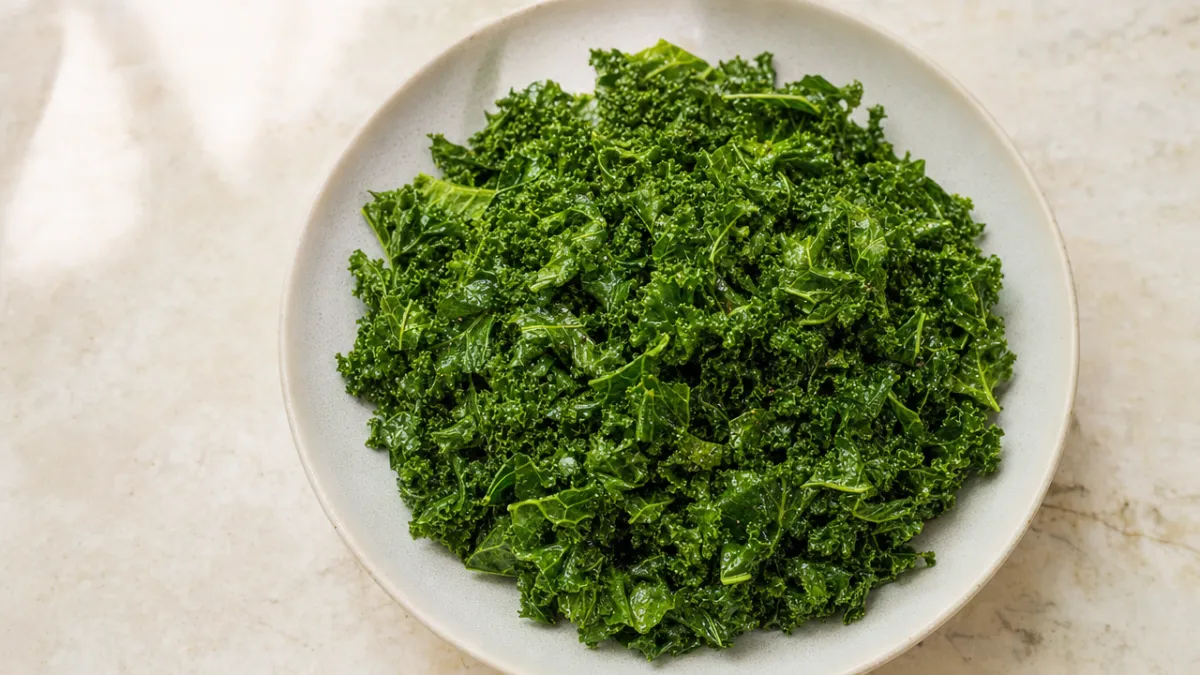
Raw kale is tough and fibrous, and low-fiber diet guidance directs avoiding raw, uncooked vegetables during active symptoms in favor of cooked, softened ones. Cooking or finely chopping kale breaks down some of that structural fiber and makes it easier to manage.
During a flare
Skip raw kale salads or smoothies during a flare; try small amounts of well-cooked, chopped, or wilted kale instead.
In remission
Raw kale (massaged salads, smoothies) is usually fine to reintroduce as tolerated, chewed well.
What the research says about kale and UC
Kale's rating comes from texture more than chemistry. Cleveland Clinic's low-fiber diet guidance lists raw vegetables and tough, fibrous greens among the foods to avoid when fiber must be limited, and raw kale is one of the most fibrous leaves in the produce aisle: thick ribs, tough cell walls, and a chew that most people notice even with a healthy gut. The American Gastroenterological Association's general IBD diet tips point in the same direction, suggesting cooked vegetables over raw during a flare and encouraging people to reintroduce foods in small amounts and keep track of what happens. Neither source singles kale out, which is itself informative: it is treated as one of the raw, fibrous greens rather than a special case.
Kale is a cruciferous vegetable like broccoli and cabbage, but it has far less of the gas reputation, likely because a serving of leaves contains less of the fermentable sugar than a serving of florets or a wedge of cabbage. The sources cited here do not discuss that directly. What they support is a simple contrast: raw kale in a salad or a smoothie delivers intact insoluble fiber all at once, while kale cooked until wilted, with stems removed and leaves chopped, is much closer to cooked spinach in how it behaves. There is no ulcerative colitis research on kale specifically behind either page.
If you have Crohn's instead of UC
I have UC, not Crohn's, so this part is research rather than experience.
If you have Crohn's with a stricture, raw kale deserves more caution than it does with UC, and how finely it is broken down matters as much as whether it is cooked. A raw kale leaf is leathery, and the thick center rib is tougher still. Cleveland Clinic's low-fiber guide says that with strictures the goal is food broken into small particles so it does not get stuck. The AGA's 2024 practice update adds that cooking or processing produce to a soft consistency may help people with symptomatic strictures eat a wider range of plant foods.
So for someone with a narrowing, a thoroughly blended kale soup or smoothie with the ribs removed is a different proposition from a massaged kale salad. How smooth is smooth enough is a question for a dietitian who knows your stricture.
Based on: Cleveland Clinic; American Gastroenterological Association (AGA); National Institutes of Health (PMC), from Gastroenterology 2021 (DINE-CD). More on how Crohn's and UC diets differ.
Ways to make it gentler
- cook, wilt, or finely chop rather than eating whole-leaf raw
- remove tough stems
Safer swaps
- cooked spinach
- cooked zucchini
How I handle kale
I treat kale as a cooked vegetable first and a salad green a distant second. During a flare I might use a small handful of chopped leaves, stems stripped out, wilted in olive oil or stirred into soup until it is fully soft. Even then it is not my first choice; cooked spinach or zucchini does the same job with less chewing. In remission I go back to kale salads, but I massage the leaves with oil and salt until they soften and darken, chop them small, and keep the portion modest. Green smoothies with raw kale I hold off on, because blending does not remove the fiber, it just hides it, and a smoothie makes it easy to drink two servings of raw kale without noticing. Kale chips, baked crisp, are a remission snack and I chew them properly.
How much, and how to test it
A quarter cup of cooked, stemmed, chopped kale is a fair first test, stirred into a soup or wilted plainly, alongside foods you already tolerate. Watch the next day or two for cramping, gas, or visible undigested leaf. If that is fine, build to half a cup cooked, then try massaged raw kale in a small salad once in remission, then a blended smoothie. If raw kale brings back symptoms, cooked kale is often still fine, so drop back rather than dropping the vegetable.
What you get from kale
Kale is one of the more nutrient-dense greens: very high in vitamin K, high in vitamin A and vitamin C, and a useful plant source of calcium and some iron, at around 40 calories per 100 grams. Calcium and vitamin K both matter for bone health after corticosteroids, and iron matters when anemia is a concern, though plant iron is absorbed less efficiently than iron from meat. Cooking concentrates the nutrients per bite and makes the fiber easier to handle.
Why this one shows up on trigger lists
Kale is flagged for one of the properties that most commonly cause UC symptoms. Each page explains the mechanism and lists every other food that carries it.
Questions people ask about kale and UC
Can I eat kale salad with colitis?
During a flare, raw kale salad is one of the harder salads to manage, because kale is among the toughest raw greens and low-fiber guidance suggests skipping raw vegetables. In remission, a massaged kale salad with the leaves softened and chopped small is often fine in a modest portion. If you want salad during a flare, small amounts of soft lettuce or a cooked-vegetable salad are gentler starting points than kale.
Is cooked kale okay for ulcerative colitis?
For many people, yes, in small portions with the stems removed. Wilting or simmering kale breaks down much of the structural fiber that makes it hard to digest raw, and chopping it finely helps further. It is still more fibrous than cooked spinach, so it usually comes later in a reintroduction sequence, but soft cooked kale in soup is a reasonable way to keep a dark leafy green in the diet.
Are kale smoothies good for UC?
Blending breaks kale into small pieces but does not remove the insoluble fiber, and a smoothie makes it easy to consume a large amount of raw kale quickly. During a flare that is usually a poor combination. In remission, a small amount of kale in a smoothie is often tolerated. Starting with a mostly fruit or yogurt base and one small handful of leaves is a sensible test.
Which type of kale is easiest to digest?
Lacinato, also called dinosaur or Tuscan kale, has flatter, more tender leaves than curly kale and tends to cook softer, which many people find easier. Baby kale is the mildest of all and closer to spinach. Whatever the type, removing the thick center rib makes the biggest difference, since the rib is the most fibrous part of the leaf.
Should people with Crohn's disease eat leafy greens like kale?
For many, yes, as part of an overall eating pattern rather than as a remedy. The AGA's 2024 practice update advises a Mediterranean-style diet for people with IBD unless there is a reason not to. In the DINE-CD trial, 194 adults with mild to moderate Crohn's did about as well on a Mediterranean diet as on the stricter Specific Carbohydrate Diet, and the authors concluded the Mediterranean approach may be preferred for most. The trial had no usual-diet group, and neither source tested kale on its own.
Recipes that use kale
Sources
- Low-Fiber Diet: What It Is and Foods To Eat (Cleveland Clinic)
- Inflammatory bowel disease (IBD): Diet tips (American Gastroenterological Association)
- Diet and nutritional therapies in patients with IBD (American Gastroenterological Association (AGA))
- A Randomized Trial Comparing the Specific Carbohydrate Diet to a Mediterranean Diet in Adults with Crohn's Disease (National Institutes of Health (PMC), from Gastroenterology 2021 (DINE-CD))
Written by Jude Horak, a UC patient. Sources last checked 2026-08-12. Spotted an error? Tell me.