Can I eat kiwi with ulcerative colitis?
By Jude Horak, UC patient. Sources checked 2026-08-12.
Also searched as: kiwifruit.
Have Crohn's instead? Jump to the Crohn's notes
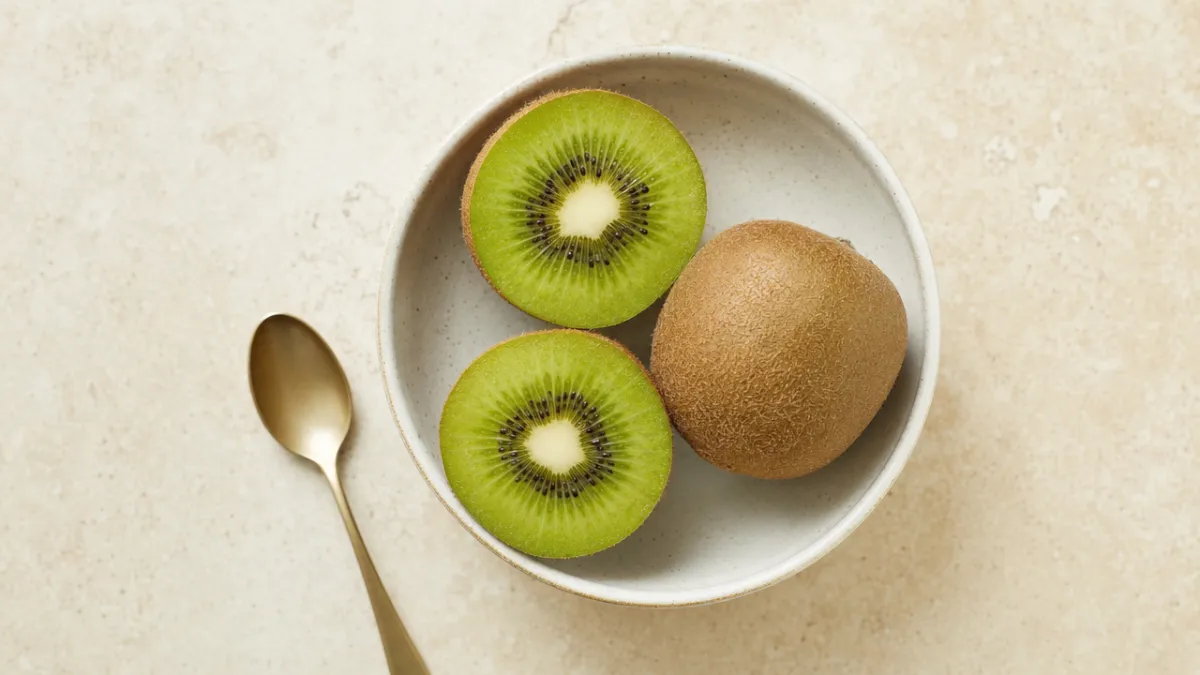
Kiwi is low-FODMAP, but it's naturally high in fiber and is usually eaten with its small edible seeds intact, similar to berries, which can add insoluble bulk during active inflammation.
During a flare
Best trialed peeled and in small amounts during a flare, given its fiber content, even though it isn't a high-FODMAP fruit.
In remission
Generally well tolerated in remission for most people.
What the research says about kiwi and UC
Kiwi is a fruit the sources rate favorably on sugar and cautiously on fiber. The Monash University FODMAP list classifies kiwifruit, both green and gold, as low-FODMAP at a standard serving of two small fruit, so it avoids the fructose and sorbitol issues that drive most fruit restrictions. Cleveland Clinic's nutrition guidance for Crohn's and colitis does not mention kiwi by name; its general advice to limit raw fruit with seeds and to peel fruit during a flare is what puts kiwi in the caution column, since the flesh is dotted with small edible seeds and the fruit is comparatively high in fiber for its size.
Neither source studied kiwi in UC patients, and the fiber concern is an inference from general guidance rather than a documented kiwi-specific problem. One thing the sources do not cover but patients often raise is that kiwi has a mild laxative reputation in the general population, partly from its fiber and partly from actinidin, an enzyme that breaks down protein. In someone with a settled gut that is neutral or even welcome; during a flare with diarrhea it is a reason to go slowly. Peeling removes the fuzzy skin, which is the toughest fiber, but the seeds remain. Ripeness matters too, since a soft ripe kiwi is far less acidic and less firm than a hard one.
If you have Crohn's instead of UC
I have UC, not Crohn's, so this part is research rather than experience.
If you have Crohn's without a narrowing, kiwi follows much the same path as in UC; a stricture is what changes it. Peeling removes the fuzzy skin but not the ring of small black seeds around the center, and the pale core itself is firmer and more fibrous than the surrounding flesh. Crohn's & Colitis UK lists fruit seeds among the foods people with a stricture may be advised to avoid.
ESPEN guidance for symptomatic small bowel strictures, reported in a 2024 Nutrients review, favors fruit that is pureed, soft or peeled. For kiwi that means very ripe fruit with the core cut out, mashed or blended, then pushed through a sieve if the seeds are a concern. A dietitian can help judge whether that level of preparation is needed for a particular narrowing.
Based on: Crohn's & Colitis UK; National Institutes of Health (PMC), from Nutrients 2024; National Institutes of Health (PMC), from Gut 1985. More on how Crohn's and UC diets differ.
Ways to make it gentler
- Peel before eating
- Start with a small portion
Safer swaps
- cantaloupe
- banana
How I handle kiwi
Kiwi is a fruit I keep for remission and treat with a little respect even then. It is low in the sugars that cause me trouble, which is a point in its favor, but the seeds and the fiber add up, and it has a gentle laxative reputation that I do not want to test during a flare. When I do eat it, I choose fruit that gives easily to a squeeze, peel it completely rather than scooping it, and eat one with a meal instead of two on an empty stomach. Gold kiwi is softer and less tart than green, and I find it the easier of the two to start with. In a flare I skip it. There are enough gentler fruits that I do not need to argue with something seeded and fibrous while my gut is unhappy.
How much, and how to test it
One small ripe kiwi, peeled and eaten with a meal, is a sensible first trial in remission or late recovery. Watch for looser stools and any lower cramping over the next day or two, keeping in mind that kiwi can speed transit slightly even in people without UC. If the single fruit is comfortable, a second one on another day is a reasonable next step; two is the serving Monash rates as low-FODMAP. If things loosen, hold at one, try gold rather than green, and stay clear of it during any active symptoms.
What you get from kiwi
One kiwi provides roughly 45 calories, more vitamin C than an orange, a good amount of vitamin K, some vitamin E, folate, and about 215 mg of potassium, with around 2 grams of fiber. The vitamin C aids iron absorption, useful against UC-related anemia, and vitamin K supports bone health, which matters after steroid treatment. Kiwi is about 83 percent water. It contains actinidin, a protein-digesting enzyme, and essentially no protein or iron of its own.
Why this one shows up on trigger lists
Kiwi is flagged for one of the properties that most commonly cause UC symptoms. Each page explains the mechanism and lists every other food that carries it.
Questions people ask about kiwi and UC
Can I eat kiwi with ulcerative colitis?
In remission, most people can, usually peeled and one at a time to start. During a flare it is commonly held back because the seeds and fiber content add residue to an inflamed colon, even though kiwi is low in fermentable sugars. Ripe, soft fruit is gentler than firm. If you find kiwi speeds things up even when you are well, it is worth keeping it to one fruit with a meal.
Is kiwi low FODMAP?
Yes. The Monash University FODMAP list rates both green and gold kiwifruit as low-FODMAP at a serving of two small fruit. That means the bloating and loose stools that many people with UC get from apples, pears, or mango are not expected from kiwi. The reason kiwi is still rated caution during a flare is fiber and seeds, not sugar, so peeling and portion matter more than FODMAP counts here.
Can you eat kiwi with diverticulitis?
This site is written for ulcerative colitis, and the two conditions differ, though both tend to involve a low-fiber phase during active symptoms. For UC, kiwi's seeds and fiber are the reason to hold it back in a flare. Older diverticular advice to avoid every small seed has been questioned in recent years, but anyone with diverticulitis should follow guidance specific to that condition rather than a colitis food page.
Can I eat kiwi while taking antibiotics?
That is a question for your pharmacist, since it depends on the specific drug, and this page does not give medication advice. What can be said from the UC side is that antibiotics often loosen stools by themselves, and kiwi has a mild laxative reputation, so during a sensitive stretch the two may add up. Holding kiwi until the course is finished is a low-cost way to avoid muddying the picture.
Why might kiwi bother someone with Crohn's who has no stricture?
Individual tolerance plays a large part. In a 1985 Italian trial of Crohn's without narrowing, 86 percent of people allowed a normal diet still dropped at least one permitted food because it seemed to disagree with them, even though eating freely did not worsen their disease overall. Kiwi can also speed transit a little in people without any gut condition, so looser stools after eating it may reflect that effect rather than anything specific to Crohn's.
Recipes that use kiwi
Sources
- FODMAP food list (Monash University FODMAP)
- A Nutritional Plan for Anyone Living With Crohn's Disease or Ulcerative Colitis (Cleveland Clinic)
- Food and Crohn's or Colitis (Crohn's & Colitis UK)
- Dietary Fiber in Inflammatory Bowel Disease: Are We Ready to Change the Paradigm? (National Institutes of Health (PMC), from Nutrients 2024)
- Low residue or normal diet in Crohn's disease: a prospective controlled study in Italian patients (National Institutes of Health (PMC), from Gut 1985)
Written by Jude Horak, a UC patient. Sources last checked 2026-08-12. Spotted an error? Tell me.